




What Is Rhinoplasty?
How Does Rhinoplasty Work?
Is Rhinoplasty for Looks, Breathing, or Both?
What Techniques Does Dr. Anderson Use?
Am I a Good Candidate for Rhinoplasty?
What Is Recovery Like After Rhinoplasty?
Meet Dr. Daniella Anderson
Rhinoplasty FAQs
Rhinoplasty, commonly called a nose job, reshapes the bones, cartilage, and soft tissue of the nose. It can refine appearance, improve breathing, or both. Dr. Daniella Anderson, MD performs rhinoplasty at Naples Aesthetic Institute. Consultations are private and in-person, so your evaluation gets the time it deserves.
What Is Rhinoplasty?
Your nose is built from bone, cartilage, and skin working together to shape your face and help you breathe. Rhinoplasty is a surgical procedure that reshapes these structures. It can change how your nose looks, how well you breathe, or both. At Naples Aesthetic Institute, Dr. Anderson performs rhinoplasty. Naples and Fort Myers, FL patients count on her for individualized surgical planning. Every surgical plan starts with your goals, your anatomy, and an honest conversation about what surgery can and cannot do.
Is Rhinoplasty for Looks, Breathing, or Both?
Rhinoplasty addresses two different sets of concerns, and Dr. Anderson evaluates both at every consultation.
For Appearance
Many patients want to change how their nose looks. Common goals include smoothing a bump on the bridge or refining a wide, drooping tip. Other patients want to narrow a bridge that feels too broad for the rest of their face. The goal isn’t a different nose. It’s your nose, brought into better balance with your other features.
For Both
For many patients, appearance and breathing concerns come from the same anatomy. A crooked nose often means a crooked septum underneath. Dr. Anderson can address both concerns in one surgery, with one recovery.
For Breathing
Some patients deal with a stuffy nose, chronic congestion, or noisy breathing at night. These problems often trace back to a crooked septum. They can also come from a weak point where the nostril meets the cheek, called the nasal valve. One clinical outcomes study found that septum-repair patients reported significantly improved breathing with no complications. When a breathing problem is medically diagnosed, part of your procedure may be covered by insurance.
What Techniques Does Dr. Anderson Use?
Open vs. Closed Rhinoplasty
Closed rhinoplasty places every cut inside the nostrils, leaving no visible scarring. It works well for smaller, focused changes. Open rhinoplasty adds one small cut on the strip of skin between the nostrils, called the columella. This gives Dr. Anderson a direct view of your nasal structure for more complex reshaping or revision surgery. She recommends the approach that fits your anatomy, not a one-size-fits-all default.
Structural vs. Dorsal Preservation Rhinoplasty
Structural rhinoplasty removes a bump on the bridge and rebuilds the middle of the nose with cartilage supports. Dorsal preservation rhinoplasty instead lowers or repositions the entire nasal roof as one unit, keeping its natural lines intact. This approach is described in published rhinoplasty technique comparisons. Both are legitimate, well-studied techniques. Dr. Anderson chooses based on your nose’s shape, skin thickness, and airway anatomy, not a marketing preference.
Choosing the Right Cartilage
Sometimes your septum doesn’t provide enough cartilage for your surgical plan. When that happens, Dr. Anderson may use cartilage from your ear or, in revision cases, from your rib. A large cartilage-graft study found a warping rate near 3% and a revision rate near 2%. These rates applied to patients who received rib cartilage. Dr. Anderson will walk you through your options, and the reasoning behind each one, at your consultation.
Am I a Good Candidate for Rhinoplasty?
Good candidates are in good general health and have finished facial growth, usually by age 15 to 17. They can also describe the specific change they want in their own words.
You may need to wait if you have an active nasal infection, an uncontrolled health condition, or currently smoke. The same is true if you’re hoping surgery will fix concerns unrelated to your nose. It also applies if you have significant, untreated body image concerns. Published rhinoplasty screening protocols show that patients with severe symptoms are generally not good surgical candidates. Patients with milder concerns, however, can do well with careful screening beforehand.
Your consultation includes a health history review, a physical exam of your nose, and imaging. Together, you and Dr. Anderson use these to agree on a plan before surgery.

What Is Recovery Like After Rhinoplasty?
Following Dr. Anderson’s before and after surgery instructions is the single biggest factor in how smoothly your recovery goes.
Week 1: You’ll wear a small splint, sometimes called a nose cast, and possibly internal support, for about a week. Bruising around the eyes peaks around day two and fades within a week to ten days. Most patients return to light activity within a few days.
Weeks 2 to 4: Visible swelling drops quickly. You’ll feel comfortable in public, though your nose is still settling into its final shape.
Months 1 to 6: The tip of your nose, which swells the longest, continues to refine gradually.
Year 1: Your final result is in. Rhinoplasty heals slowly by nature, and this timeline holds true no matter which technique Dr. Anderson uses.
Meet Dr. Daniella Anderson
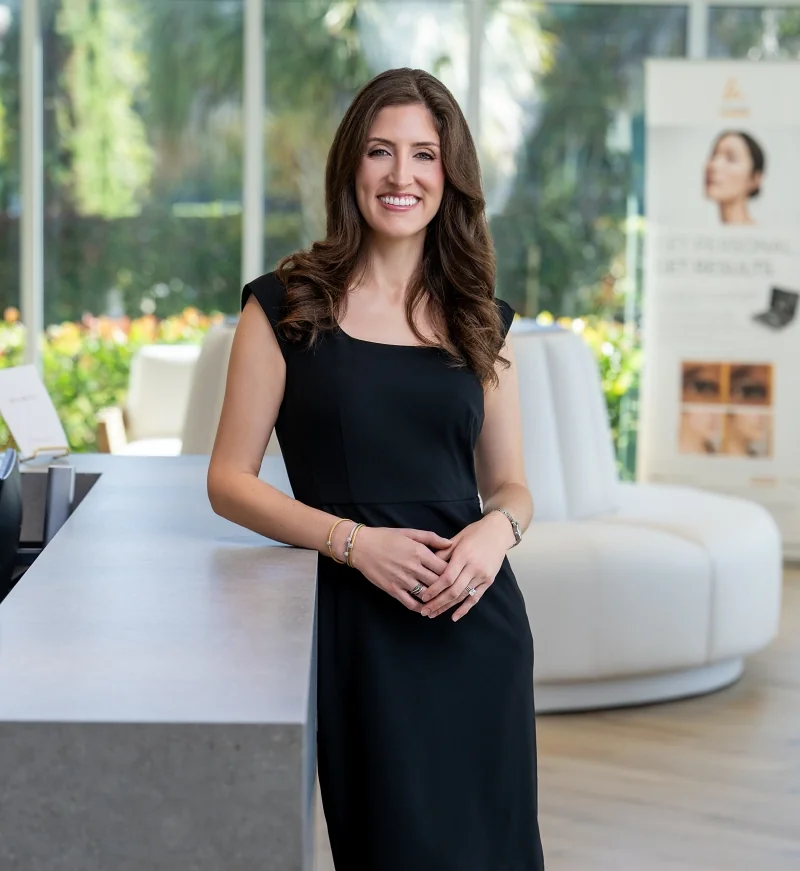
Dr. Daniella Anderson, MD is a plastic and reconstructive surgeon at Naples Aesthetic Institute. She completed a six-year residency in plastic and reconstructive surgery at Corewell Health / Michigan State University, serving as chief resident. She holds a medical degree from Florida International University’s Herbert Wertheim College of Medicine.
During her residency, she completed more than 7,700 surgical cases and over 1,500 aesthetic procedures.
Her approach starts with listening. She believes the best results come from understanding what you want to change, and why it matters to you. That understanding shapes every surgical plan.

Why Patients Choose Naples Aesthetic Institute for Rhinoplasty
- Individualized surgical planning. Every plan reflects your anatomy, your goals, and your airway, not a template.
- Boutique, judgment-free care. Private consultations and unhurried appointments, from your first visit through your final follow-up.

Most primary rhinoplasty procedures take about two to three hours under general anesthesia. Complex or revision cases may take longer. Dr. Anderson will give you a specific time estimate based on your surgical plan.
Most visible swelling fades within two to three months. The fine details, especially at the tip, keep refining for up to a year. This is a normal part of how nasal tissue heals, not a sign that anything went wrong.
Closed rhinoplasty leaves no visible scars because every cut is inside the nostrils. Open rhinoplasty leaves one small scar on the strip of skin between the nostrils. It typically fades and becomes difficult to see over time.
Purely cosmetic rhinoplasty is not covered by insurance. Functional rhinoplasty, performed to correct a deviated septum or another breathing problem, may be partially covered. Coverage depends on your carrier and documentation. Our team can review your specific situation at your consultation.
Yes. Once you’ve healed, your results are considered permanent. Your nose will still change subtly with normal aging over the decades. Rhinoplasty carries a small chance of needing a follow-up procedure. Published rhinoplasty revision data puts that rate at around 5%. That’s why surgeon experience and honest candidacy screening both matter.
Yes. Many patients pair rhinoplasty with facelift or eyelid surgery for balanced, natural-looking results across the face. Dr. Anderson can plan complementary procedures together in a single consultation.
Yes. We welcome patients seeking rhinoplasty in Fort Myers to travel to our Naples office for private consultations. Dr. Anderson builds every surgical plan the same way, regardless of where you’re traveling from.

Schedule
Your Rhinoplasty Consultation Today
If you’re considering rhinoplasty in Naples or Fort Myers, FL, schedule a private, in-person consultation with Dr. Anderson. Together, you’ll build a surgical plan around your anatomy and your goals. A consultation fee applies.

1Heilbronn C, Cragun D, Wong BJF. Complications in Rhinoplasty: A Literature Review and Comparison with a Survey of Consent Forms. Facial Plast Surg Aesthet Med. 2020;22(1):50-56. https://doi.org/10.1089/fpsam.2019.29007.won
2Patel PN, Abdelwahab M, Most SP. Combined Functional and Preservation Rhinoplasty. Facial Plast Surg Clin North Am. 2021;29(1):113-121. https://doi.org/10.1016/j.fsc.2020.09.005
3Goldfarb JM, Taylor CM, Barrera JE. Patient-Reported Outcome Measures Including Nasal Breathing Improvement After Functional Rhinoplasty Using Endonasal Septal Extension Grafting. Facial Plast Surg Aesthet Med. 2024;26(4):446-450. https://doi.org/10.1089/fpsam.2023.0205
4Chen H, Wang X, Deng Y. Complications Associated with Autologous Costal Cartilage Used in Rhinoplasty: An Updated Meta-Analysis. Aesthetic Plast Surg. 2023;47(1):304-312. https://doi.org/10.1007/s00266-022-03075-3
5Shandilya M, Bourke S, Shandilya A. Surgical Rhinoplasty in Mild Forms of Body Dysmorphic Disorder: Safety, Protocols, and Long-Term Outcomes. Facial Plast Surg. 2024;40(5):565-570. https://doi.org/10.1055/s-0044-1779627
The Doctors at Naples Aesthetic Institute have either authored or reviewed and approved this content.